 View All Solutions

Introduction
In an interest rate and liquidity environment that can shift quickly, treasurers need funding tools that are both flexible and easy to manage. An Advance Ladder is a funding strategy that can spread borrowings across multiple maturities instead of concentrating them on a single date, or on a single product. This staggered approach helps members manage refinancing risk by smoothing out funding costs, and aligning liabilities with the natural cashflow rhythm of their assets, resulting in a more controlled and predictable liquidity profile
Laddering is not just an asset-liability management (ALM) exercise; it is a strategic way to make funding decisions more manageable over time. By avoiding large, one-time refinance events, laddering turns funding into a series of smaller, more manageable decisions. This reduces exposure in any interest rate environment and supports more stable net interest income (NII). Members can use FHLBank Chicago Advances for funding ladder strategies to better match asset cash flows, satisfy regulatory expectations for stable funding, strengthen liquidity planning and align balance sheet needs with evolving market conditions.
Why Advance Ladders: The Case for Staggered Funding
Members may take unnecessary concentration risk when their funding profile relies on a few large bullet maturities, such as increasing sensitivity to interest rate movements. These “cliff events” can force refinancing under unfavorable market conditions.
An Advance Ladder spreads advance maturities over time (often across two to five years) so only a portion of funding rolls in any given environment. This helps smooth funding costs, reduces exposure to interest rate spikes, and helps manage refinancing decisions.
Most asset portfolios do not mature in one large block. Instead, assets tend to roll off gradually across multiple tenors. An Advance Ladder allows treasurers to align liabilities with asset cash flows. This improves duration alignment, reduces asset-liability mismatch, and helps stabilize NII. Where portfolios involve meaningful amortization of assets, adding amortizing advances to the ladder creates a liability pattern that mirrors the underlying asset behavior.
Advance Ladders also strengthen liquidity metrics and make stress testing easier. Rather than facing a single decision point, treasurers get multiple opportunities to adapt to interest rate changes, deposit moves or widening spreads. Because the structure of the Advance Ladder is modular—reminiscent of how building blocks can be combined and rearranged—members can size or reshape advance “rungs” by adding advances with strategic, staggered maturities as their outlook evolves.
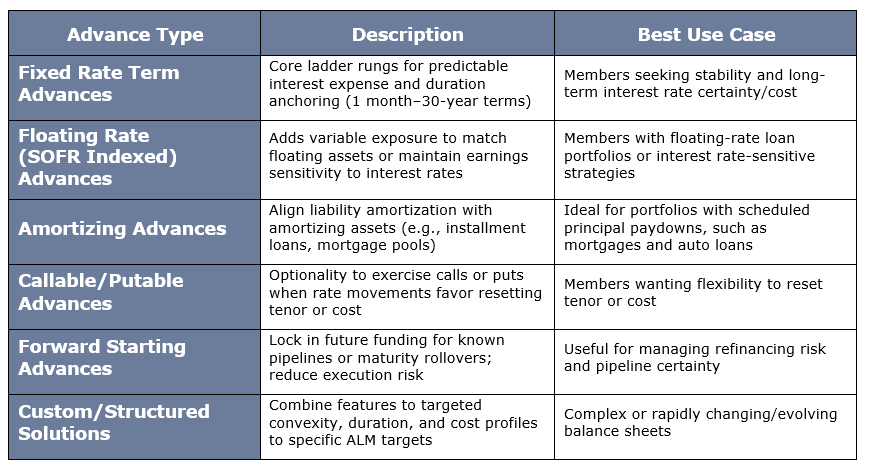
FHLBank Chicago’s wide variety of advance products, including those with optionality (for example, callable and putable advances), adds another layer of flexibility. It allows individual rungs to be resized or restructured when market conditions move in the member’s favor, without rebuilding the entire ladder.
Designing the Ladder: A Strategic Blueprint
Building an effective funding Advance Ladder starts with clearly defining objectives and guardrails, and typically involves the following inputs:
- Defining a target effective duration (often 2.5 to 3 years)
- Setting acceptable earnings sensitivity limits under interest rate shocks
- Establishing liquidity buffers and concentration limits
- Analyzing asset cash flows by rate type, amortization, and growth expectations
These inputs help identify the appropriate spacing and sizing of ladder rungs and improve alignment between assets and liabilities and can increase the stability of NII.
Evaluate your desired tenor mix and construct advance rungs with annual maturities spanning several years aligned to asset duration and growth plans. Determine the blend of fixed and floating rate advances to achieve the desired net interest income behavior and interest rate sensitivity. Where appropriate, incorporate amortizing rungs to reduce mismatch and enhance predictability. Members may incorporate advances with embedded options, such as callable or putable advances. Overlay strategies—such as swaps, caps, or floors—can further fine-tune exposure and help keep the ladder aligned with balance-sheet objectives.
Ongoing monitoring and maintenance help keep Advance Ladders effective over time. Establishing a regular quarterly review cadence allows members to refinance maturing advance rungs at the far end of the ladder, preserve ladder length, and rebalance structures asset mix or interest rate outlook changes.
How to Structure an Advance Ladder
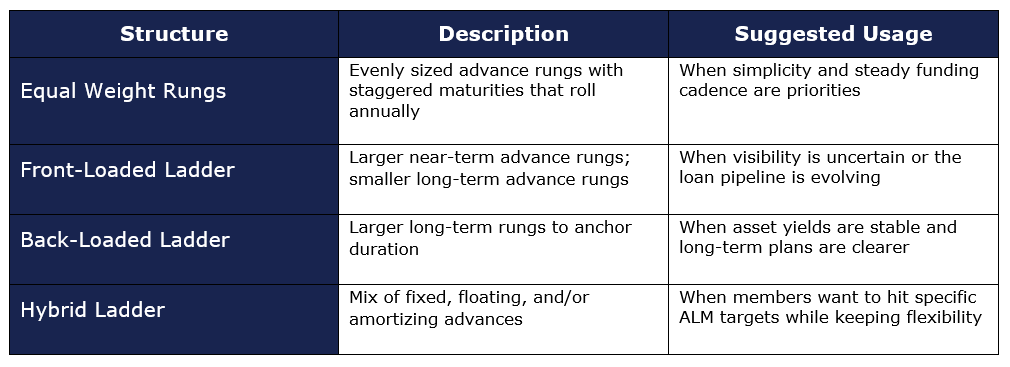
Example. A member seeking $50 million in term funding could structure five $10 million advance “rungs” with staggered annual maturities over five years. Each year, the maturing rung is rolled to the far end of the ladder, allowing the structure to evolve based on current market conditions, and the member’s asset mix and funding needs.
Summary of Benefits
Advance Ladders transform funding from a series of one-off decisions into a disciplined, modular strategy. By staggering advance maturities and blending advance structures, members can reduce refinancing risk, improve duration matching, and support more stable earnings across interest rate cycles.
FHLBank Chicago makes laddering simple and effective. As your strategic partner, we provide more than funding; we deliver flexibility and insight. Our advance products include fixed-rate term funding, SOFR-based floaters, amortizing and callable structures, forward-starting options, as well as customizable products—all designed to fit your balance sheet objectives.
The result is a resilient liability framework that adapts to market conditions, supports liquidity planning, and enhances earnings stability.
To discuss how an Advance Ladder could support your funding and liquidity strategy, contact your FHLBank Chicago sales director or visit our Contact Us page.
Download a PDF of this White Paper.
Author
 | Richard J. GillVP, Director, Member Solutions |
Appendix A: Sample Advance Ladder Design (Conceptual) for $100M to Fund a Mixed Asset Profile
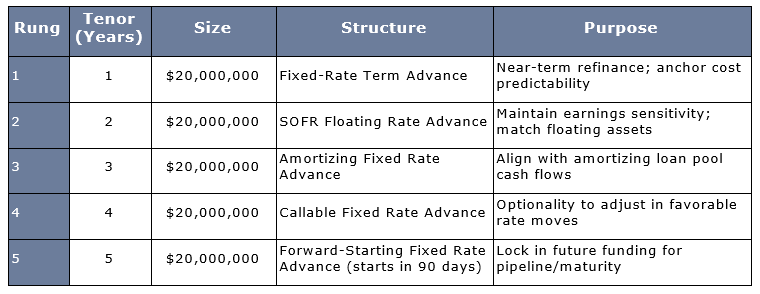
Each year, the maturing advance rung is rolled to the far end of the Advance Ladder at the optimal tenor/structure at the time; advance rungs can be resized to reflect asset changes and strategy updates.
Disclaimer
The scenarios in this paper were prepared without any consideration of your institution’s balance sheet composition, hedging strategies, or financial assumptions and plans, any of which may affect the relevance of these scenarios to your own analysis. The Federal Home Loan Bank of Chicago (FHLBank Chicago) makes no representations or warranties (express or implied) about the accuracy, currency, completeness, or suitability of any information in this paper. This paper is not intended to constitute legal, accounting, investment, or financial advice or the rendering of legal, accounting, consulting, or other professional services of any kind. You should consult with your accountants, counsels, financial representatives, consultants, and/or other advisors regarding the extent these scenarios may be useful to you and with respect to any legal, tax, business, and/or financial matters or questions. In addition, certain information included here speaks only as of the date(s) included, and the information may have become out of date. FHLBank Chicago does not undertake an obligation, and disclaims any duty, to update any of the information in this paper. Moreover, this paper may include forward-looking statements, which are based upon FHLBank Chicago’s current expectations and speak only as of the date(s) thereof. These forward-looking statements involve risks and uncertainties including, but not limited to, the risk factors set forth in FHLBank Chicago’s periodic filings with the Securities and Exchange Commission, which are available on its website.